Thursday, April 21, 2011

Electrons in an Atom

Niels Bohr proposed that atoms exist in energy levels surrounding the nucleus.

Electrons exist in two states:
1. Ground state- when electrons are in their lowest possible energy level
2-Excited State-when one or more electrons of an atom are in energy levels above their lowest possible level.

An energy level is the amount of energy an electron can possess.
The quantum of energy is the difference in energy between two levels.

Recall that electrons exist in shells,which are sets of orbitals having the same 'n' value
and an orbital is  the space an electron takes up in a particular energy level.
A subshell is a set of orbitals of the same type.

There are 4 different types of orbitals
S, D, P and F.
Each subshell has

1 S Orbital
3 P orbitals
5 D orbitals
7 F orbitals

This means that the most electrons you can put in

S subshell- 2
P subshell- 6
D subshell-10
F subshell-14

This is governed by Pauli's Exclusion Principle which states that each orbital contains 2 electrons max.
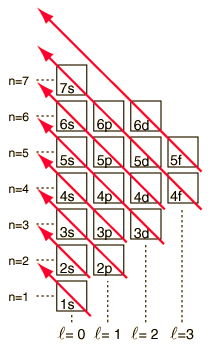


This is a diagram which will help when filling orbitals.

To write the electronic configuration of neutral atoms:

1) The Aufbau Principle states that you must start with the lowest energy level.
2) Figure out how many electrons you have.
3)According to the diagram, that is the order you follow, so 1s,2s,2p etc..
4. Remember how many electrons in each subshell
5) Keep filling until you run out of electrons.

Example 1:

Oxygen- has 8 electrons.

So 1s^2 2s^2 2p^4

You write the name of the subshell and then the number of electrons in it as an exponent.

Example 2:

Krypton has 36 electrons.

1s^2 2s^2 2p^6 3s^2 3p^6 4s^2 3d^10 4p^6

Note that 4p^6 is filled up. This is because krypton is a noble gas.
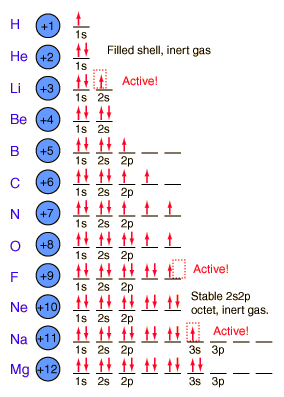

This is the visual way to display electron configuration. Note how each shell is filled with up and down arrows because they have opposite spins. Remember to fill each subshell with all up arrows and then go back and fill the down arrows.

Another way to display electron configuration is to use core notation.

The core-the set of electrons with the configuration of the nearest noble gas

The outer part of an atom- the electrons other than the core.


How:

1) Locate the closest noble gas to that element on the periodic table.
2) Cite the noble gas in [ ] and then write the rest of the configuration.

Example 3:

Nitrogen:
Has 7 electrons= 1s^2 2s^2 2p^3

What you do is backtrack and find the nearest noble gas. Go backward across the periodic table(left) until you run off the table and come out one level up on the right side.

In this case the nearest NG is helium.

Its atomic number is 2 so, [He].
Then eliminate the first 2 electrons from the configuration and add the rest.

2s^2 2p^3

[He] 2s^2 2p^3.


Exceptions
Instead of: Cr --> [Ar] 4s^23d^4
Cu--> [Ar] 4s^23d^9
In actuality:
Cr--> [Ar] 4s^13d^5
Cu--> [Ar] 4s^13d^10 

http://www.youtube.com/watch?v=YURReI6OJsg&feature=relmfu 

That should help!


Tuesday, April 19, 2011

Atomic Number, Mass and Mass Number- Subatomic Particles

Today we learned about the different characteristics of modern atoms.

Recall that an atom is made up of 3 types  of subatomic particles.

The Proton
Has a charge of +1.
Has a mass of 1.
Location: Nucleus

The Electron
Has a charge of -1
Has a mass of (not equal to) zero
Location: Energy shells surrounding nucleus

The Neutron
Has a charge of 0
Mass of >1.
Location: Nucleus

The atomic number(Z) of an element is the number of protons in its nucleus.

Atoms can form ions, which are charged atoms.
To form a negative ion(anion) electrons must be added to a neutral atom.
To form a positive ion(cation) electrons must be taken away from a neutral atom.

To find the charge of an atom: # Protons- #Electrons.

The mass number of an element is the sum of its protons and neutrons
The atomic mass is the average of masses of existing isotopes of an element.

An isotope of an element always has the same number of protons but a different number of neutrons.

How to calculate atomic mass.

Three naturally occurring isotopes with their percent abundance.

12(60%), 13(36%), 14(4%)

Calculate atomic mass.

12 x 60%= 7.2
13 x 36% = 4.68
14 x 4% = 0.56

Now add: 7.2 + 4.68 + 0.56 = 12.4.

Monday, April 18, 2011

Atomic Theory

The history of atomic theory has evolved over thousands of years. Several new ideas, concepts and models have been put forth and have contributed to our understanding of the structure of an atom.

Democritus- believed that matter was made up of atoms. Had a theory that atoms remain unchanged but move about in space to form macroscopic objects.

Aristotle- His theory was that atoms were made up of 4 elements; earth, wind, fire and water. When these elements combine they created dryness, wetness, coldness and hotness.

Antoine Lavoisier- accidentally discovered oxygen and created an incomplete table of the elements. Created early version of Law of 1) Definite Proportions 2) Conservation of Mass

Joseph Proust- created the Law of Definite Proportions-a given compound always has the same elements in the same proportions by mass.

John Dalton- he proposed Dalton's Atomic Theory
1. elements are made up of atoms
2.atoms of same elements are identical
3.atoms of different elements can be told apart by atomic weight
4.atoms of different elements can combine in a reaction to form chemical compounds in fixed ratios.

JJ Thomson-proved the existence of the electron, proposed the raisin bun model of the atom.

 Ernest Rutherford- discovered the positively charged, central, dense nucleus.
Did this using his gold foil experiment in which he fired radioactive particles through thin foil; most passed through but some particles were reflected.

Niels Bohr- proposed the planetary model of the atom
-Electrons exist in energy levels surrounding the nucleus.
-studied gaseous samples of atoms


The Atom today:
It is the smallest particle of an element and cannot be broken down.
It contains 3 subatomic particles- the proton(+), the electron(-) and the neutron (0).
The protons and the neutrons occupy the nucleus and electrons exist in levels around the nucleus.


Tuesday, April 5, 2011

Percent Yield and Percent Purity

Today we learned the last things for the test.


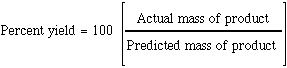
1) Percent Yield: it is the amount of actual product obtained as a percentage of the theoretical amount of product.

It is found using the formula:

Actual mass produced(g) / theoretical mass produced(g)

Lets try some problems!!!!

Example :

The reaction SiO2(s) + 4 HF(g) -----> SiF4(g) + 2H2O(l) produces 3.0 grams of H2O when 13.30 g of SiO2 is treated with small excess of HF.

What mass of SiF4 is formed?

Looking back at previous lessons this is fairly straightforward.


Mass of SiF4 formed:

3.0 g H20 x 1mole/ 18.0 x 1SiF4/2H20 x 104.1/1 mole=8.7 g of SiF4


What mass of SiO2 is left unreacted?

Mass of SiO2 used - 3.0 g H2O x 1mole/18.0 x 1 SiO2/2H2O x 60.1/1mole=5.0 g SiO2

13.30-5.0 g = 8.3 g SiO2 in excess

What is percent yield of reaction?

amount of SiF4 expected:  13.30 g SiO2 x 1 mole/ 60.1 x 1 SiF4/1SiO2 x 104.1/1mole = 23.0 g SiF4

Now remember Percent Yield is amount obtained/amount expected x 100

8.7/23 x 100 = 37 .8% yield.


Percent Purity:

(Mass of pure substance/mass of impure substance) x100

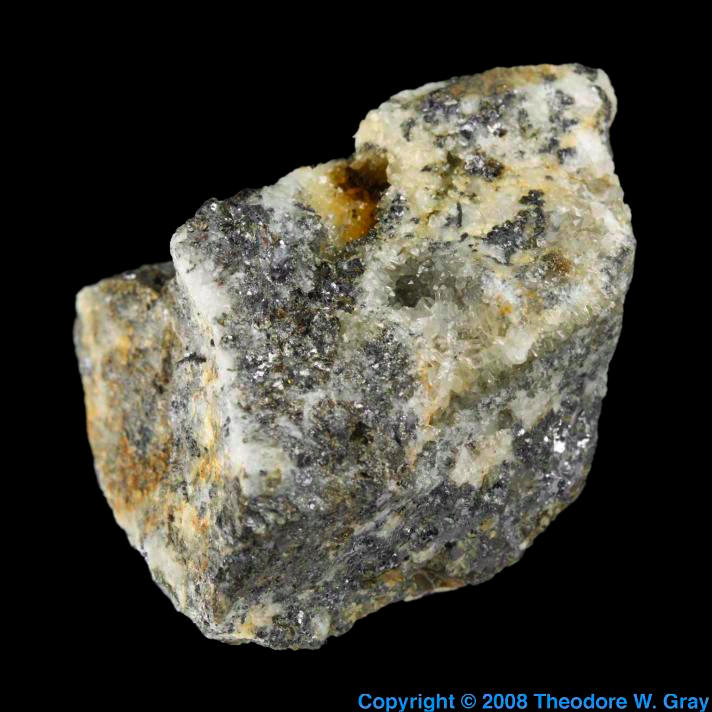
If the mass of silver ore is 66.4 grams and contains 12.0 g of pure silver what is percent purity?

12.0/66.4
x 100 = 18.1 % purity


http://www.youtube.com/watch?v=LicEaaXhlEY

Tuesday, March 15, 2011

Lab 6D: Determining the Limiting Reactant and Percent Yield in a Precipitation Reaction

CaCl2(aq) + Na2CO3(aq) -----> CaCO3(s) + NaCl(aq)

In this lab we observed the double replacement reaction between sodium carbonate and calcium chloride. We determined the excess and limiting reagents of the reaction, a theoretical and actual mass. After doing this we determined percent yield of the reaction.

Equipment:
-2 25 mL graduate cylinders
-1 250 mL beaker
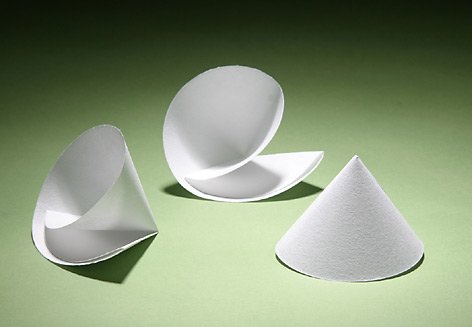
-filter paper
-ringstand

After filling the cylinders with sodium carbonate and calcium chloride we added the calcium chloride to the sodium carbonate in a beaker. We then obtained a piece of filter paper, and weighed it. We wrote our names on the paper and then set up an apparatus for filtering using a ringstand. We poured the new solution carefully, bit by bit into the funnel. The filter paper filtered out the new precipitate, which was  CaCO3. We then let the filter paper and precipitate dry and then weighed it again.


NEXT CLASS WE WILL LEARN PERCENT YIELD!!

Friday, March 11, 2011

Excess and Limiting Reactants


All the reactions we've done up until now assume that all reactants are completely used up during reaction. This is not the case. Often, reactants are in excess; there is some left over.

Here is an example:

What mass of CS2 is produced when 18.0 g of C are reacted with 41.0 g of SO2?

5 C + 2 SO2-------> CS2 + 4 CO

What mass of excess reactant is left over?

Here try and find mass of CS2 by using the masses of the reactants C and SO2.

Mass of CS2 (based on C) 18.0 g C x 1 mole/ 12.0 x 1 CS2/5 moles C x 76.2 / 1 mole= 22.9 g CS2

Mass of CS2 (based on SO2)  41.0 g SO2 x 1 mole/ 64.1 x 1 CS2/2 SO2 x 76.2/ 1mole = 24.4 g CS2

Since there is too much SO2 and not enough C, SO2 is the excess reactant because in the reaction all the C will be used  up and the SO2 will be in excess.

In this reaction, C is the limiting reactant because it limits the amount of CS2 that can be formed, there is lots of SO2 and not enough C to make that much SO2.

Example #2. What mass of P4 is produced when 38.0 g of Ca3(PO4)2, 25.0 g of SiO2 and 9.70 g of C are reacted?

2 Ca3(PO4)2 + 6 SiO2 + 10 C -----> P4 + 6 CaSiO3 + 10 CO

Use the mass of each reactant and find the mass of P4.

Mass of P4( based on Ca3(PO4)2)38.0 g Ca3(PO4)2 x 1 mole/ 310.3 x 1 P4/2 Ca3(PO4)2 x 124.0/1 mole = 7.59 g P4

Mass of P4 ( based on SiO2) 25.0 g SiO2 x 1 mole/60.1 x 1 P4/ 6 SiO2 x 124.0/1mole = 8.60 g P4

Mass of P4 (based on C) 9.70 g C x 1mole/12.0 x 1 P4/ 10 C x 124/1mole= 10.0 g P4.

Ca3(PO4)2 produces the least amount of P4 = 7.59 g

The excess reactants are  SiO2 and C.

How many grams of excess reactant are left over?

38.0 g Ca3(PO4)2 x 1mole/ 310.3 x 6 SiO2/2 Ca3(PO4)2 x 60.1/1 mole = 22.1 g SiO2.

To calculate excess, subtract this number from the original amount.

25.0 - 22.1 = 2.9 g SiO2 in  excess.

38.0 g Ca3(PO4)2 x 1 mole/310.3 x 10 C/ 2 Ca3(PO4)2 x 12.0 / 1mole =7.35 g C

Subtract from original.


9.70 g- 7.35 = 2.35 g excess C


http://www.youtube.com/watch?v=JOQz2rIFpVM

Xtra help above :)

Monday, March 7, 2011

Stoichiometry with Molarity and STP

Today we learned how to solve stoichiometry problems involving molarity and STP.


Remember Molarity =M


M=moles/Litres or moles= M/L  or moles/M = L

Example:
A tablet of Tums has a mass of 0.750 g. What volume of stomach acid(HCl) = 0.010 M is neutralized by a 0.750g portion of CaCO3?

1CaCO3(s) + 2 HCl(aq) ----> CaCl2(aq) + CO2(g) + H2O(l)

First find moles of HCl using stoichiometry.
0.750 g CaCO3 x 1 mole/100.1 g CaCO3 x 2 mol HCl/1 mol CaCO3 = 0.0150 mol

Now find the Litres using the molarity equation.
L= moles/Molarity
0.0150 mol/0.0010 mol/L = 15 L.

Now remember STP.

STP stands for Standard Temperature and Pressure

The conversion factor is 22.4 L / 1 mole or 1 mole/22.4 L.

You do the exact same thing with the other problems but when you have your desired substance in moles, you just multiply by 22.4 L / 1mole to find volume at standard temperature and pressure.

Example:
What volume of CO2(g) at STP is produced if 1.25 L of 0.0055 M HCl reacts with an excess of CaCO3?

First you find moles of the HCl.

moles = Molarity x litres

0.0055 M x 1.25 = 0.006875 mol HCl

Now just find the moles of CO2 using stoichiometry.

0.006875 x 1 mol CO2/ 2mol HCl

Now multiply by 22.4 L/ 1 mole.

Your answer will be 0.077 L CO2.

http://www.youtube.com/watch?v=z4nPxk1deuw
Here is some extra help!