Today we learned about alkenes and alkynes.
They are different from alkanes because they can form double(alkene) and triple(alkyne) bonds.
Alkenes are formed with double bonds between carbon atoms and the ending is -ene.
Example.
Let us name this.
If this was an alkane, it would end in -ane and its name would be 2-methylpentane.
However it is an alkene as evidenced by the double bond.
Therefore the name is 4-methyl
Then you write the number of the carbon# the double bond comes after so 2-pent-ene
so the name of this compound is 4-methyl-2-pentene.
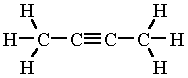
Alkynes are exactly the same as alkenes except when you name it, change the ending to -yne. They use triple bonds.
Name this.
First count the parent hydrocarbon.
=4 so Butane.
Then you take into account the triple bond so the name changes to butyne.
Since there are no branched hydrocarbons, nothing needs to be added except the position of the triple bond.
This is added in front of the word butyne
It is 2-butyne.
http://www.youtube.com/watch?v=7XbYhjyUI-M
Tuesday, May 31, 2011
Sunday, May 29, 2011
Organic Chemistry
Organic Chemistry is the study of compounds containing carbon. These compounds can be formed in several ways, and may appear in a straight line, circular or branched pattern. They also have low melting points. To combine with other atoms they can form single,double or triple bonds.
A hydrocarbon is a compound containing only carbon and hydrogen.
Alkane: A saturated hydrocarbon involving only single bonds.
Here are some examples of alkanes:
The chemical formula for alkanes is CNH2N+2
Methane: CH4
Ethane: C2H6
Propane : C3H8
Butane: C4H10
* An alkyl group is an alkane that loses an atom of hydrogen.
A branched hydrocarbon is a hydrocarbon attached to the original carbon atom.
Thursday, May 19, 2011
Chemical Bonding
Chemical bonding is molecules and atoms being attracted to each other and this allows them to combine to form chemical compounds.
There are 3 types of bonding:
Ionic Bonding: Is the transfer of atoms to form positive or negative ions.
Non-Polar Covalent Bonding- Is the unequal sharing of electrons
Polar Covalent Bonding : sharing of electrons equally.
IONIC:
Ionic bonding involves metal and non-metals. The force that powers ionic bonding is called the electrostatic force, which is the attraction or repulsion of charged particles. Electronegativity is also an important concept behind this bonding. Metal electronegativity is low and non metal electronegativity is high. As result, a high ionization energy is created. To determine how electrons are shared, electronegativity difference must be found.
ENeg Diff= ENeg 1 - ENeg 2
ENeg Diff less than 0.5 it is a non polar
ENeg Diff greater than 0.5 and less than 1.8 is is polar covalent bond
ENeg Diff greater than 1.8 is it ionic
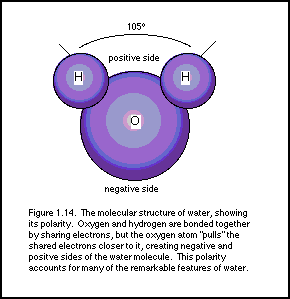
Polarity: is the electrical balance or imbalance of the molecule. If the molecule is electrically unbalanced, then it is polar. This is caused by electronegativity. If the EN is high, the shared electrons will be pulled more to the atom. A partial negative results from high electronegativity and a partial positive results from a low one.
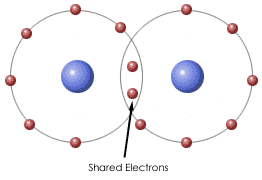
In a Non- polar bond, it is one of the simplest, only involving the sharing of electrons to create full valence shells. Intramolecular forces in the molecule hold the atoms of the molecule together.
However, intermolecular forces act between molecules and are responsible for bonding.
A London force is a weak intermolecular force. They occur because of temporary dipolar attractions. A dipole is when one side is slightly positive and the other side is slightly negative ,creating partial separation.
There are 3 types of bonding:
Ionic Bonding: Is the transfer of atoms to form positive or negative ions.
Non-Polar Covalent Bonding- Is the unequal sharing of electrons
Polar Covalent Bonding : sharing of electrons equally.
IONIC:
Ionic bonding involves metal and non-metals. The force that powers ionic bonding is called the electrostatic force, which is the attraction or repulsion of charged particles. Electronegativity is also an important concept behind this bonding. Metal electronegativity is low and non metal electronegativity is high. As result, a high ionization energy is created. To determine how electrons are shared, electronegativity difference must be found.
ENeg Diff= ENeg 1 - ENeg 2
ENeg Diff less than 0.5 it is a non polar
ENeg Diff greater than 0.5 and less than 1.8 is is polar covalent bond
ENeg Diff greater than 1.8 is it ionic
Polarity: is the electrical balance or imbalance of the molecule. If the molecule is electrically unbalanced, then it is polar. This is caused by electronegativity. If the EN is high, the shared electrons will be pulled more to the atom. A partial negative results from high electronegativity and a partial positive results from a low one.
In a Non- polar bond, it is one of the simplest, only involving the sharing of electrons to create full valence shells. Intramolecular forces in the molecule hold the atoms of the molecule together.
However, intermolecular forces act between molecules and are responsible for bonding.
A London force is a weak intermolecular force. They occur because of temporary dipolar attractions. A dipole is when one side is slightly positive and the other side is slightly negative ,creating partial separation.
Tuesday, May 10, 2011
Drawing Electron Dot Diagrams and Lewis Dot Diagrams
Let us examine an example of an electron dot or Lewis diagram.
1. The centre of the diagram, the atomic symbol represents the nucleus.
2. Each dot represents an electron in an electron dot diagram. These are only the valence electrons, or the electrons in the outermost shell.
3. In a Lewis diagram, lines represent a bond between two electrons.
Here is an example. Because Nitrogen has 5 valence electrons and hydrogen has 1. Hydrogen needs 1 electron to become full and nitrogen needs 3.
Therefore, in NH3, N and H share electrons so that H is full with 2. and N, being surrounded on 3 sides gets 3 electrons.
In a structural diagram, electron bonds can be represented with a ---(line)
In Ionic compounds:
As you can see here, sodium has 1 valence electron and chlorine has 7.
Sodium and chlorine both want to become happy, and they are attracted to each other. The sodium loses its valence electron and becomes (+)1 charge. Chlorine takes this electron and fills it valence shell, giving it a (-1) charge. Therefore, this is how the Lewis diagram is shown.
Extra help!
http://www.youtube.com/watch?v=y6QZRBIO0-o
http://www.youtube.com/watch?v=QKoA3fZ29B0
Saturday, April 30, 2011
Periodic Trends
As we examine the periodic table each elements have certain characteristics and looking at the periodic table as a whole, some trends are noticed.
Recall that Dmitri Mendeleev created a periodic table of the 63 known elements which he arranged by atomic mass.
First we must know some important vocab.
Density: of an object is its mass per unit volume. It increases as the atomic numbers increase.
Ionization energy: is the energy needed to remove electrons from an atom. It increases as you go across a period(left----> right) and decreases as you go down in families.
Melting and Boiling Points: This is the temperature at which an object liquefies and becomes a gas respectively.
These properties increase as you go from bottom to top in a group.
Electronegativity: This is the tendency of an atom or functional group to attract electrons towards itself(form negative ions) In increases left------------->right
Atomic Radius: Is the measure of the size of an atom. It decreases left to right and increases going down.
Recall that Dmitri Mendeleev created a periodic table of the 63 known elements which he arranged by atomic mass.
First we must know some important vocab.
Density: of an object is its mass per unit volume. It increases as the atomic numbers increase.
Ionization energy: is the energy needed to remove electrons from an atom. It increases as you go across a period(left----> right) and decreases as you go down in families.
Melting and Boiling Points: This is the temperature at which an object liquefies and becomes a gas respectively.
These properties increase as you go from bottom to top in a group.
Electronegativity: This is the tendency of an atom or functional group to attract electrons towards itself(form negative ions) In increases left------------->right
Atomic Radius: Is the measure of the size of an atom. It decreases left to right and increases going down.
Tuesday, April 26, 2011
Valence Electrons
Are the ones involved in chemical reactions
An open shell is a shell that has less than the maximum amount of electrons in it.
A closed shell is a shell that is completely full with the max. amount of electrons that can occupy it.
How to determine the number of valence electrons from electronic configurations:
Sodium: has 11 electrons.
1s^2 2s^2 2p^6 3s^1
Now we must put it into core notation:
[Ne] 3s^1
When counting valence electrons, only the s and p subshells are considered, unless the d and f subshells are full.
Therefore, Na has one valence electron.
http://www.youtube.com/watch?v=1TZA171yxY4&feature=fvwrel
Cheers
Thursday, April 21, 2011
Electrons in an Atom
Niels Bohr proposed that atoms exist in energy levels surrounding the nucleus.
Electrons exist in two states:
1. Ground state- when electrons are in their lowest possible energy level
2-Excited State-when one or more electrons of an atom are in energy levels above their lowest possible level.
An energy level is the amount of energy an electron can possess.
The quantum of energy is the difference in energy between two levels.
Recall that electrons exist in shells,which are sets of orbitals having the same 'n' value
and an orbital is the space an electron takes up in a particular energy level.
A subshell is a set of orbitals of the same type.
There are 4 different types of orbitals
S, D, P and F.
Each subshell has
1 S Orbital
3 P orbitals
5 D orbitals
7 F orbitals
This means that the most electrons you can put in
S subshell- 2
P subshell- 6
D subshell-10
F subshell-14
This is governed by Pauli's Exclusion Principle which states that each orbital contains 2 electrons max.
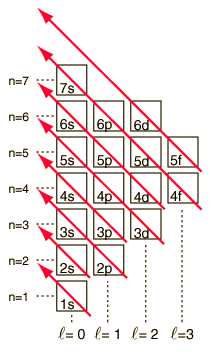
This is a diagram which will help when filling orbitals.
To write the electronic configuration of neutral atoms:
1) The Aufbau Principle states that you must start with the lowest energy level.
2) Figure out how many electrons you have.
3)According to the diagram, that is the order you follow, so 1s,2s,2p etc..
4. Remember how many electrons in each subshell
5) Keep filling until you run out of electrons.
Example 1:
Oxygen- has 8 electrons.
So 1s^2 2s^2 2p^4
You write the name of the subshell and then the number of electrons in it as an exponent.
Example 2:
Krypton has 36 electrons.
1s^2 2s^2 2p^6 3s^2 3p^6 4s^2 3d^10 4p^6
Note that 4p^6 is filled up. This is because krypton is a noble gas.
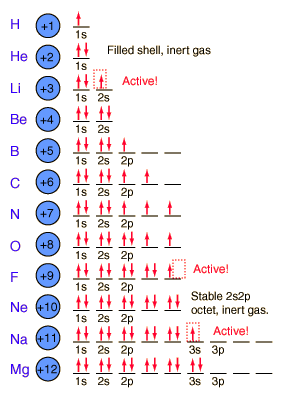
This is the visual way to display electron configuration. Note how each shell is filled with up and down arrows because they have opposite spins. Remember to fill each subshell with all up arrows and then go back and fill the down arrows.
Another way to display electron configuration is to use core notation.
The core-the set of electrons with the configuration of the nearest noble gas
The outer part of an atom- the electrons other than the core.
How:
1) Locate the closest noble gas to that element on the periodic table.
2) Cite the noble gas in [ ] and then write the rest of the configuration.
Example 3:
Nitrogen:
Has 7 electrons= 1s^2 2s^2 2p^3
What you do is backtrack and find the nearest noble gas. Go backward across the periodic table(left) until you run off the table and come out one level up on the right side.
In this case the nearest NG is helium.
Its atomic number is 2 so, [He].
Then eliminate the first 2 electrons from the configuration and add the rest.
2s^2 2p^3
[He] 2s^2 2p^3.
Exceptions
Instead of: Cr --> [Ar] 4s^23d^4
Cu--> [Ar] 4s^23d^9
In actuality:
Cr--> [Ar] 4s^13d^5
Cu--> [Ar] 4s^13d^10
http://www.youtube.com/watch?v=YURReI6OJsg&feature=relmfu
That should help!
Electrons exist in two states:
1. Ground state- when electrons are in their lowest possible energy level
2-Excited State-when one or more electrons of an atom are in energy levels above their lowest possible level.
An energy level is the amount of energy an electron can possess.
The quantum of energy is the difference in energy between two levels.
Recall that electrons exist in shells,which are sets of orbitals having the same 'n' value
and an orbital is the space an electron takes up in a particular energy level.
A subshell is a set of orbitals of the same type.
There are 4 different types of orbitals
S, D, P and F.
Each subshell has
1 S Orbital
3 P orbitals
5 D orbitals
7 F orbitals
This means that the most electrons you can put in
S subshell- 2
P subshell- 6
D subshell-10
F subshell-14
This is governed by Pauli's Exclusion Principle which states that each orbital contains 2 electrons max.
This is a diagram which will help when filling orbitals.
To write the electronic configuration of neutral atoms:
1) The Aufbau Principle states that you must start with the lowest energy level.
2) Figure out how many electrons you have.
3)According to the diagram, that is the order you follow, so 1s,2s,2p etc..
4. Remember how many electrons in each subshell
5) Keep filling until you run out of electrons.
Example 1:
Oxygen- has 8 electrons.
So 1s^2 2s^2 2p^4
You write the name of the subshell and then the number of electrons in it as an exponent.
Example 2:
Krypton has 36 electrons.
1s^2 2s^2 2p^6 3s^2 3p^6 4s^2 3d^10 4p^6
Note that 4p^6 is filled up. This is because krypton is a noble gas.
This is the visual way to display electron configuration. Note how each shell is filled with up and down arrows because they have opposite spins. Remember to fill each subshell with all up arrows and then go back and fill the down arrows.
Another way to display electron configuration is to use core notation.
The core-the set of electrons with the configuration of the nearest noble gas
The outer part of an atom- the electrons other than the core.
How:
1) Locate the closest noble gas to that element on the periodic table.
2) Cite the noble gas in [ ] and then write the rest of the configuration.
Example 3:
Nitrogen:
Has 7 electrons= 1s^2 2s^2 2p^3
What you do is backtrack and find the nearest noble gas. Go backward across the periodic table(left) until you run off the table and come out one level up on the right side.
In this case the nearest NG is helium.
Its atomic number is 2 so, [He].
Then eliminate the first 2 electrons from the configuration and add the rest.
2s^2 2p^3
[He] 2s^2 2p^3.
Exceptions
Instead of: Cr --> [Ar] 4s^23d^4
Cu--> [Ar] 4s^23d^9
In actuality:
Cr--> [Ar] 4s^13d^5
Cu--> [Ar] 4s^13d^10
http://www.youtube.com/watch?v=YURReI6OJsg&feature=relmfu
That should help!
Subscribe to:
Posts (Atom)